

On January 1, 2027, a new Dutch law takes effect: the Wet toelating terbeschikkingstelling van arbeidskrachten (Wtta). This law introduces a new admission system for companies that hire out workers. It also sets new requirements for companies that hire in workers.
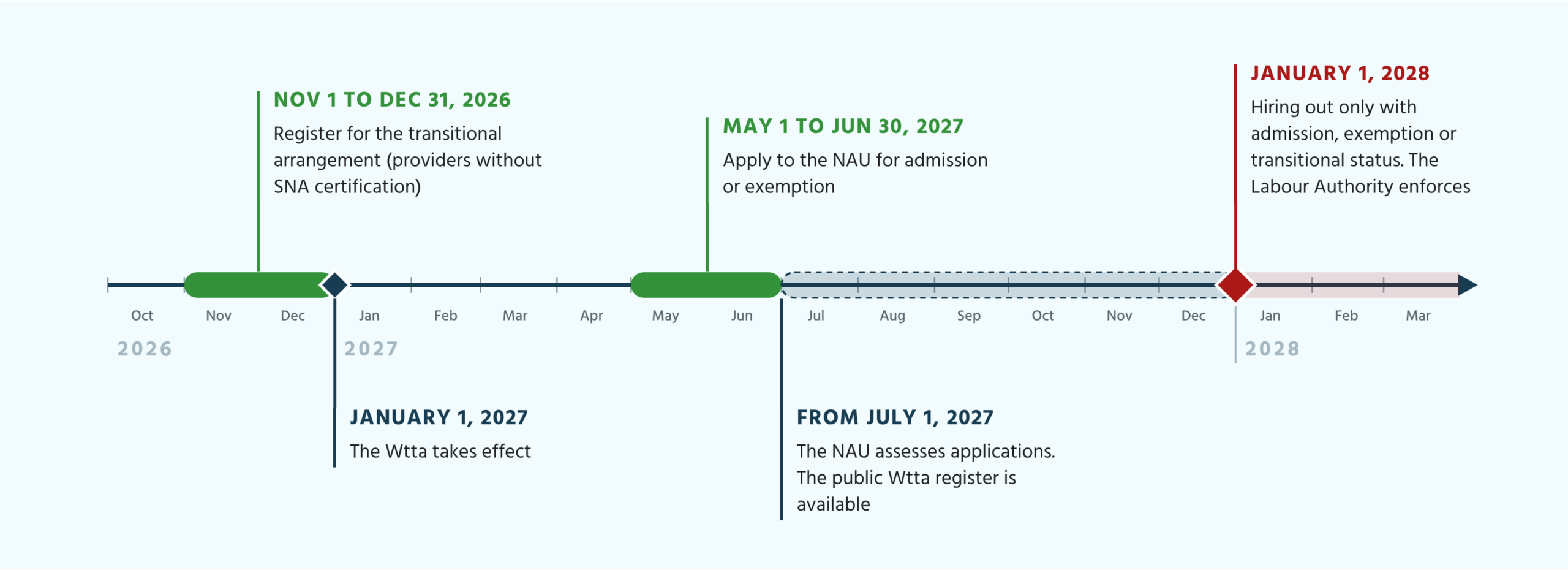
From January 1, 2028, compliance with the law will be enforced. From that date, you may only hire out workers if you hold an admission (toelating) or an exemption (ontheffing) from the Dutch Labor Supply Market Authority (Nederlandse Autoriteit Uitleenmarkt, NAU). Foreign staffing providers that supply workers in the Netherlands are also subject to this obligation. User companies may then only do business with admitted staffing providers or with providers that have been granted an exemption.
The Wtta applies to both staffing providers and user companies
- The NAU defines hiring out workers as making workers available to another party, for a fee, to work under that party’s direction and supervision. This covers not only temporary employment agencies, but also payroll companies, secondment agencies and businesses that occasionally hire out staff. Foreign companies that hire out staff in the Netherlands may also fall under the law.
- A user company is the party to which workers are made available to work under its direction or supervision.
The key question is therefore who directs and supervises the work. If your employee works at a client’s premises and receives daily instructions there, this will quickly qualify as hiring out workers, and your company falls under the Wtta. In a genuine contract for work, where the contractor delivers a defined result and remains in charge, the Wtta admission requirement does not apply. Likewise, a self-employed professional (zzp’er) who works directly for clients and decides how the work is done and how the result is achieved is not considered a staffing provider under the Wtta. Please note: a self-employed professional is considered a staffing provider if they accept an assignment and deploy other self-employed professionals who work under the client’s direction and supervision.
Separate exemptions apply to a number of sectors. Whether your situation falls under an exemption depends heavily on the facts. If in doubt, have it assessed.
Admission requirements for staffing providers
To be admitted, a staffing provider must meet requirements that include:
- registration in the Trade Register of the Netherlands Chamber of Commerce (KVK);
- a valid Certificate of Conduct (Verklaring Omtrent het Gedrag, VOG) for the company;
- financial security in the form of a security deposit of €100,000 (or €50,000 for new staffing providers with a provisional admission), unless you are exempt;
- demonstrable compliance with the relevant employment, social security and tax laws (“the standards framework”), shown by an inspection report from an inspection body designated by the NAU.
Exemption for limited staffing activities and provisional admission
The Wtta allows an exemption from the admission requirement if hiring out workers is only a limited part of the business. From May 1, 2027, a staffing provider can apply to the NAU for an exemption. This is possible if you have paid wages for at least 12 months, hiring out workers accounts for less than 10% of your annual revenue, and that revenue does not exceed €5 million per year. Temporary employment agencies are excluded from the exemption. In addition, new businesses can apply for a provisional admission, because they cannot yet meet all requirements of the standards framework.
Transitional arrangement
The transitional arrangement is intended for existing staffing providers preparing for the new admission system. Existing staffing providers can register for the transitional arrangement from November 1 through December 31, 2026. Whether your company needs to register depends on whether it holds a valid SNA certification (SNA-keurmerk) on June 30, 2027.
- Company with SNA certification:registration for the transitional arrangement is not required. The company must still apply for an admission or exemption between May 1 and June 30, 2027. For a first admission application, the SNA certification can replace an inspection report.
- Company without SNA certification: the company must register with the NAU for the transitional arrangement between November 1 and December 31, 2026. It must then apply for an admission or exemption between May 1 and June 30, 2027. Under certain conditions, the inspection report may be submitted later.
If you register in time and submit your application on time, you may continue to hire out workers after January 1, 2028, for as long as the NAU has not yet made a decision. If you do not register, you must be admitted by January 1, 2028. If you are not, you will have to stop hiring out workers.
What does the Wtta mean for user companies?
From July 1, 2027, you can check a staffing provider’s status in the new public Wtta register. It shows right away whether a provider has been admitted, holds an exemption or falls under the transitional arrangement. From January 1, 2028, hiring in workers from unregistered providers is prohibited. Until then, you check staffing providers in the current Waadi register of the KVK.
Practical tips for user companies
- Before the work starts, record in writing through which staffing provider the worker is placed, including in the case of onward hiring.
- Provide the staffing provider with the correct and complete terms of employment (user company pay terms) in good time.
- Check the Wtta register regularly to confirm that the staffing provider is still admitted.
Wtta risks
The Netherlands Labour Authority (Nederlandse Arbeidsinspectie) will enforce the Wtta from January 1, 2028. The main risks at a glance:
- Staffing providers without an admission will be fined and must cease their activities immediately. This also applies to providers whose admission is suspended or revoked.
- User companies that do business with a non-admitted staffing provider are themselves in breach. The Netherlands Labour Authority can impose an administrative fine for each violation.
- In the case of repeated violations, the Netherlands Labour Authority can shut down work at the location completely.
- If you miss the deadline for the transitional arrangement, you may not hire out workers from January 1, 2028, until your final admission has been approved. This leads to an immediate loss of hired-in staff.
Wtta timeline
Do you have questions about the Wtta or about working with (foreign) agency workers? Please contact Çiğdem Özcan, employment lawyer at Ko&Co Advocaten.